The Hidden Life of the Sixth Dalai Lama (Studies in Modern Tibetan Culture) by Wickham-Smith Simon
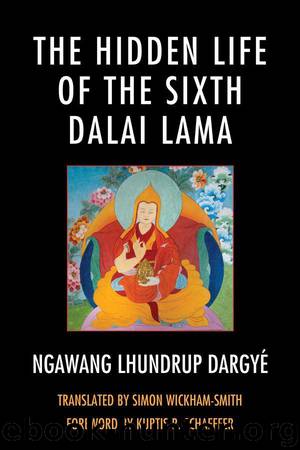
Author:Wickham-Smith, Simon [Wickham-Smith, Simon]
Language: eng
Format: azw3
Publisher: Lexington Books
Published: 2011-05-18T16:00:00+00:00
Part III
His Journey to Domé and How He Taught Those Needing Instruction
I
As a scholar has written: “Although we cannot grasp the extent of the Buddha’s extraordinary activity, nonetheless, I’ve set down here just those things which we may believe through faith.”
Like an ocean of activity, he arrived in Domé and worked for the benefit of those who needed what he taught, and he was the source from which they drank their fill.
The Great Fifth had dreamt one night that, with neither shoes nor hat nor anything else, one who embodied compassion had come to the back door of the Potala and, like an emerging army, had set off northwards. He explained this dream by saying that one day it would be he who would be in this position.
Moreover, as it explains in the text cited above, “From the top of the Potala mountain . . .” and also, “Many were led from the north of Tibet, with neither servants nor protectors, into the north.” Here, “Tibet” refers to the area of thirteen throneholders of Tibet; the first usage of “north” refers to the land of Domé, the second to Mongolia. The rest of the sentence indicates a lack of protection. It says in the Gyelpo Ké Tangyik,[1] “The twelve physical bodies of the Buddha and his children will finally be scattered.” This is explained as referring to the twelve physical lineages of the divine children who were born into the many holy clans and human lineages of the Lord Buddha. The phrase “finally scattered” is clarified by the idea of “wandering off.”
According to this teaching, “The yogic lineage of the Lord Buddha is an illusory form. An ordinary son of Mön[2] is the helmsman for gods and demons. He is referred to as the one who comes from the area of rocky mountains, like the sun’s rays at dusk. He is said perhaps to be a secret yogi, or one who formerly was king, or one blind to the teaching of the king of previous times or else one whose heart is the ocean of secret mantra. This is how the lineage is represented.”
The first part of this text is explained by saying that a holy man such as this is a yogi from the Buddha’s lineage. As for the second part, it is taught that Mön, his birthplace, is where he appeared and that “the helmsman for gods and demons” refers to the one who has grasped the implication of mantra. Thirdly, “he comes from the area of rocky mountains” means that the holy man comes from Ütsang, a place surrounded by snowy mountains: this is what everyone said when he arrived. Fourthly, “the sun’s rays” indicates the red hue at the setting of the sun, and the fact that it was from that direction that the holy man came. Fifthly, “he is said to be a secret yogi”: the majority of people at that time in Tibet were under the sway of demons and made exaggerated claims about holy men.
Download
This site does not store any files on its server. We only index and link to content provided by other sites. Please contact the content providers to delete copyright contents if any and email us, we'll remove relevant links or contents immediately.
Waking Up in Heaven: A True Story of Brokenness, Heaven, and Life Again by McVea Crystal & Tresniowski Alex(37779)
Still Foolin’ ’Em by Billy Crystal(36341)
Cecilia; Or, Memoirs of an Heiress — Volume 1 by Fanny Burney(32536)
Cecilia; Or, Memoirs of an Heiress — Volume 2 by Fanny Burney(31933)
Cecilia; Or, Memoirs of an Heiress — Volume 3 by Fanny Burney(31925)
Fanny Burney by Claire Harman(26591)
Empire of the Sikhs by Patwant Singh(23066)
We're Going to Need More Wine by Gabrielle Union(19030)
Hans Sturm: A Soldier's Odyssey on the Eastern Front by Gordon Williamson(18564)
Plagued by Fire by Paul Hendrickson(17398)
Out of India by Michael Foss(16839)
All the Missing Girls by Megan Miranda(15920)
Cat's cradle by Kurt Vonnegut(15322)
Pimp by Iceberg Slim(14476)
Molly's Game by Molly Bloom(14129)
Bombshells: Glamour Girls of a Lifetime by Sullivan Steve(14046)
For the Love of Europe by Rick Steves(13850)
Leonardo da Vinci by Walter Isaacson(13303)
4 3 2 1: A Novel by Paul Auster(12362)
